

"Am I going to tear?"
I get asked this every single shift. Usually quietly. Usually right after someone has finished asking about the epidural and is trying to sound casual.
Here's the honest answer: maybe. Some tearing is really common, especially with a first vaginal birth. Most tears are small, and most heal well. And there are a few things that may lower your odds, plus a few things that raise them that no amount of prep can change.
Let's walk through all of it. What the degrees actually mean, what may help, and the exact questions to ask your provider before you're the one pushing.
First, meet your perineum
Your perineum is the stretch of skin and muscle between your vagina and your anus. Yes, the taint.
It stretches more than you'd think. As baby's head crowns, that tissue thins and stretches around it. A tear happens when it stretches past what it can give in that moment. It isn't a sign your body did something wrong. It's tissue doing a very big job very fast.
The four degrees of tears, in plain English
Every tear gets a number from 1 to 4. The number tells you how deep it goes, one layer at a time.
1st degree: skin only. Sometimes a few stitches. Sometimes none. Often heals on its own.
2nd degree: skin and the perineal muscle under it. Usually stitched right after birth, after you're numbed.
3rd degree: into the anal sphincter, the muscle ring around your anus. Repaired soon after birth, often in the operating room with good pain relief.
4th degree: through the sphincter into the lining of the rectum. Repaired the same way as a 3rd degree tear, with closer follow-up afterward.
If you hear "graze" or "abrasion," that's a surface scrape. Those usually heal without stitches.
And an episiotomy is different from a tear. It's a cut your provider makes on purpose. Routine episiotomies aren't recommended anymore; they're saved for specific situations.
How common is tearing?
More common than anyone tells you, and less scary than it sounds.
Somewhere between about half and four in five people have some kind of tear during a vaginal birth (ACOG).
For first-time mothers in the UK, up to 9 in 10 have a tear, graze or episiotomy (Tommy's).
Most of those are 1st or 2nd degree. 3rd and 4th degree tears are much less common: about 6 in 100 first births and under 2 in 100 births after a previous vaginal birth (Tommy's).
So if you tear, you're in the majority. And most likely, it's a small one.
What raises the odds (and isn't on you)
Some things make a tear, or a deeper tear, more likely. Most of them are not things you can prep away:
A first vaginal birth
A bigger baby (over about 9 lb)
Baby facing up ("sunny side up") or breech
A very fast birth
A long pushing stage
Forceps or a vacuum
Shoulder dystocia, when baby's shoulder gets stuck after the head is out
A previous 3rd or 4th degree tear
I'm listing these so you know: if you tear, you didn't do it wrong. Your body isn't broken. Sometimes the tissue just meets a situation bigger than it can stretch for.
What may lower your odds
None of these are guarantees. Think of them as things to ask about and practice, not a promise of an intact perineum.
1. A warm compress while you push
A warm, wet cloth held on your perineum during the pushing stage. In the Cochrane review, warm compresses were linked to fewer 3rd and 4th degree tears (moderate-certainty evidence). They didn't change how many people had no tear at all, so the benefit is mainly fewer serious tears. ACOG supports them too.
2. Perineal massage in late pregnancy
Gently stretching the perineum with your fingers (or your partner's) in the last weeks of pregnancy. Many providers suggest starting around 34 to 35 weeks. Ask yours first, especially if you have a low-lying placenta, bleeding, or an infection.
The Cochrane review found it slightly lowers the chance of a tear needing stitches and of an episiotomy, mainly for first vaginal births. It didn't show a clear drop in 3rd and 4th degree tears. Small help, real help.
If fingers are hard to reach at 34 weeks (hello, belly), a perineal massage wand helps. It's on my Perineal Tears: Prevent & Heal list on Amazon, along with the recovery basics to pack in your hospital bag.
As an Amazon Associate I earn from qualifying purchases. If you buy through these links, I may earn a small commission at no extra cost to you.
3. A slower crowning
When baby's head is crowning, your nurse or provider may ask you to stop pushing hard and do small pushes, or breathe baby out. That gives the tissue time to stretch. This is part of how many hospitals try to prevent serious tears. It can feel like the hardest thing in the world to not push. Practicing the breathing ahead of time helps.
4. Asking about pushing positions
Flat on your back isn't the only option. Some evidence suggests side-lying may help lower the risk, but the research on positions is mixed overall. What's available depends on you, baby, your epidural, and what your team is seeing. Ask what positions your hospital supports, so it's not a surprise in the moment.
5. Knowing your hospital's episiotomy approach
ACOG recommends against routine episiotomies. Most hospitals follow that now, but it's still worth asking how often your provider does them and why.
Questions to ask at your next visit
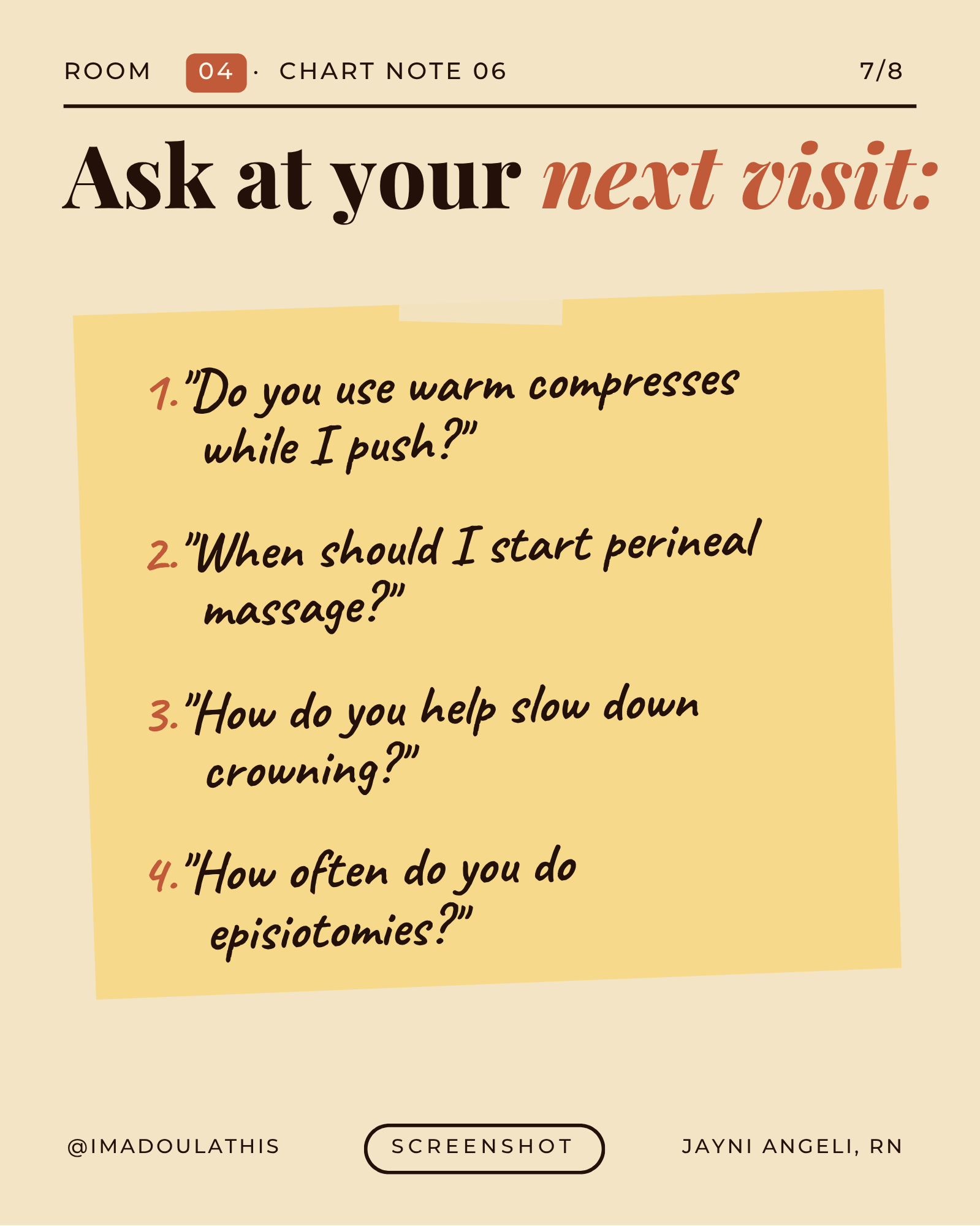
Screenshot these. Bring them to your next prenatal appointment, and make sure your partner knows them too.
"Do you use warm compresses while I push?"
"When should I start perineal massage, and is it safe for me?"
"How do you help slow things down when baby is crowning?"
"What pushing positions can I use here?"
"How often do you do episiotomies, and when?"
A provider who respects your questions will answer them without making you feel silly for asking. That alone tells you a lot.
If you do tear
After baby is out and the placenta is delivered, your provider checks your perineum. If you need stitches, you'll be numbed first. If you have an epidural, it's often already doing that job. Most stitches dissolve on their own.
For 3rd and 4th degree tears, the repair is usually done soon after birth, often in the operating room, with more pain relief and closer follow-up afterward. What that looks like varies by hospital.
Soreness for the first couple of weeks is normal. Healing is a whole topic of its own, so I wrote a separate post on it: Healing After a Perineal Tear: What's Normal, What Helps, and When to Call.
Call your provider if you have a fever, a foul smell, pain that's getting worse instead of better, or trouble controlling gas or stool. Those need to be checked, not waited out.
Quick answers
Will I definitely tear during birth? No. Many people tear, especially the first time, but not everyone does. Most tears are small.
What is the most common type of tear? 1st and 2nd degree tears. 3rd and 4th degree tears are much less common.
When should I start perineal massage? Many providers suggest around 34 to 35 weeks. Check with yours first.
Does a warm compress really help? Research links warm compresses during pushing to fewer 3rd and 4th degree tears. It doesn't guarantee no tear.
Is tearing better than an episiotomy? Routine episiotomies aren't recommended anymore. There are situations where one is the right call, so ask your provider when they would consider one.
Does an epidural make tearing more likely? The epidural itself isn't one of the main risk factors. Things that can come with it, like a longer pushing stage or forceps and vacuum, can raise the odds. Practicing slow crowning helps either way.
If you're between 20 and 34 weeks and want to practice this (the breathing, the questions, what your partner does while you push), that's exactly what we do in Bedside Birth Prep, my 1:1 coaching. Book a free call.
Further along, or not ready for coaching? Grab my free Birth Plan Template and add a line about warm compresses, slow crowning and pushing positions, so your preferences are written down before you're the one pushing. Then send this post to whoever will be at your shoulder.
Close to 36 weeks? My 3AM Toolkit ($19) walks you through the night labor starts, from the triage nurse who would be checking you in: when to go in, exactly what to say when you call, and what to do if you get sent home. Read it once, then keep the one-page 3am Card on your phone.
Sources
American College of Obstetricians and Gynecologists. Practice Bulletin No. 198: Prevention and Management of Obstetric Lacerations at Vaginal Delivery (2018). Summary via The ObG Project.
Aasheim V, et al. Perineal techniques during the second stage of labour for reducing perineal trauma. Cochrane Database of Systematic Reviews, 2017. PubMed.
Beckmann MM, Stock OM. Antenatal perineal massage for reducing perineal trauma. Cochrane Database of Systematic Reviews, 2013. Cochrane Library.
Tommy's. Perineal tears.
This post is education, not medical advice. Talk with your own provider about your body and your birth.